
05/26/2022
Challenges in the determination of two analytes with different physicochemical properties, Tapinarof and its main metabolite, Tapinarof Sulfate, at the low picogram level
The challenge of developing a new bioanalytical method considerably increases when two or more metabolites need to be simultaneously analysed. Their extraction and chromatography optimization can be further complicated if their physicochemical properties vary significantly. Method development may be even more difficult when low limits of quantitation are required, for instance, when evaluating the systemic adsorption of topical drugs.
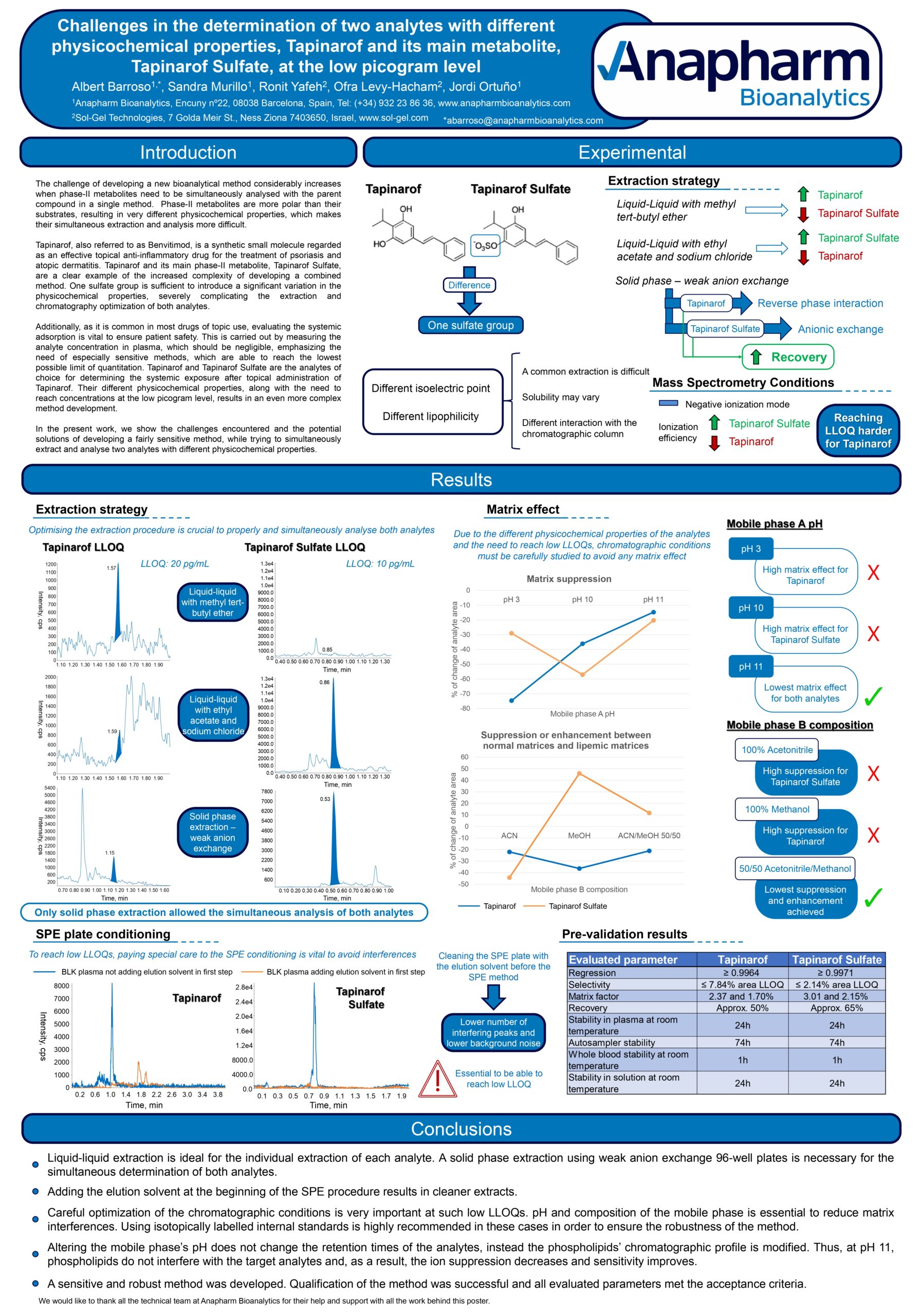
In the work we present to the 8th EBF Young Scientist Symposium, which was awarded with the "Second Best Poster Award", we show the challenges encountered and the potential solutions of developing a fairly sensitive method, while trying to simultaneously extract and analyse two analytes, Tapinarof and, its main phase-II metabolite, Tapinarof Sulfate, whose physicochemical properties are quite different.
You may find below the poster for your ready reference:


MORE NEWS
Webinar #1: Navigating Bioanalytical Challenges: from Small Molecules to Complex Peptides
In this 30-minute on-demand webinar, discover practical strategies to troubleshoot common analytical challenges, from small molecules to complex peptides, illustrated with real case studies from our laboratory.
Anti-PEG Antibodies: How Advanced Immunogenicity Testing Overcomes Detection Challenges
Detecting anti-PEG antibodies in clinical immunogenicity testing of PEGylated therapeutics presents unique bioanalytical challenges: from PEG’s repetitive structure causing low signal-to-noise ratios in standard assay formats, to selecting appropriate positive controls and distinguishing anti-drug from anti-PEG antibodies. This blog describes how the bioanalytical team at Anapharm Bioanalytics addressed these challenges during the development and validation of an immunogenicity assay using the Affinity Capture Elution–AGL (ACE-AGL) MSD immunoassay format.
Protein Digestion for LC-MS Bioanalysis: Comparing Standard and Kit-Based Methods
Quantitative bioanalysis of therapeutic proteins via liquid chromatography–mass spectrometry (LC-MS) typically relies on the analysis of surrogate peptides rather than intact proteins. Selecting the right digestion method impacts sensitivity, reproducibility, and cost. This blog compares three approaches tested in-house at Anapharm: standard trypsin digestion, the use of a kit with a thermostable immobilized trypsin, and a kit with ready-to-use reagents.