
07/24/2026
Challenges in the development of a method for the detection of Free Testosterone
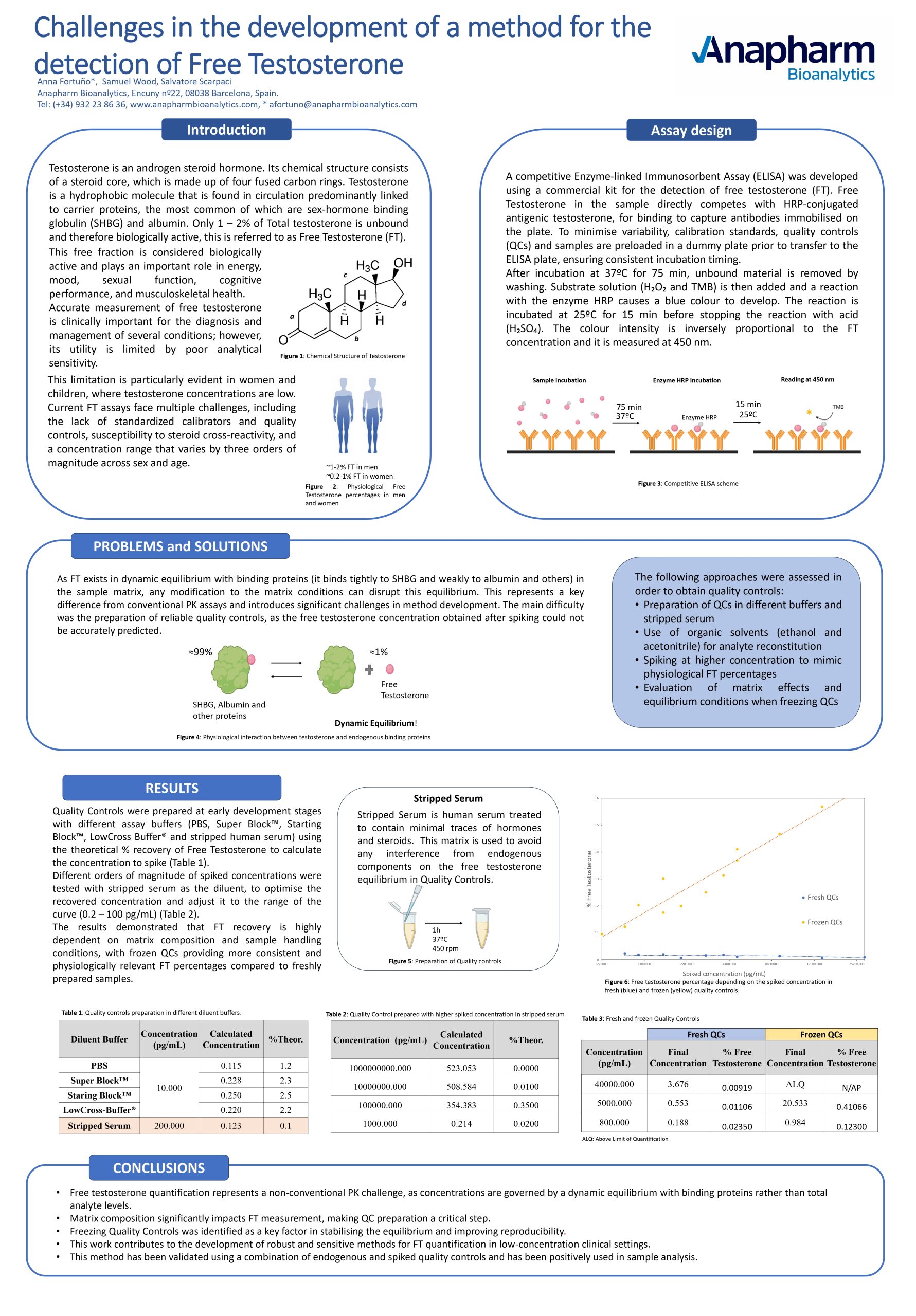
Testosterone is an androgen steroid hormone that circulates in blood predominantly bound to sex hormone-binding globulin (SHBG), weakly bound to albumin, and as a small unbound fraction known as free testosterone (FT). Testosterone exists in a dynamic equilibrium, with only ~1–2% of total testosterone being free in men and as little as 0.2–1% in women.
In the present study, for which we prepared a poster that was presented at the 12th EBF Young Scientist Symposium (please see below for your reference), we aim to optimize a competitive enzyme-linked immunosorbent assay (ELISA) for the measurement of free testosterone within a regulated pharmacokinetic (PK) framework, with the objective of achieving a sensitivity in the range of 0.2–0.6 pg/mL. This poster presents key challenges encountered during method development and validation, and discusses the strategies implemented to overcome them.
Unlike conventional PK assays that quantify non-endogenous drug concentrations, this method focuses on the free fraction of a drug with an endogenous counterpart.
As FT is in equilibrium with binding proteins in the sample matrix, any modification to matrix conditions can alter this equilibrium. A major challenge was the establishment of reliable quality controls, as predicting the resulting free testosterone concentration in drug spiked samples proved difficult. Several diluents, buffers, and sample treatments were evaluated. Treated hormone-free matrix and freezing of quality controls allowed the system to reach equilibrium and improved assay performance.
The method is being evaluated using serum samples from post-menopausal women, a population with low expected free testosterone concentrations. This work supports the development of a non-conventional PK assay, for the quantification of biologically active hormone fractions at low-concentrations.
Get in touch with our team to discuss your upcoming bioanalytical requirements — we will be pleased to support you in moving your project forward.


MORE NEWS
Anapharm Bioanalytics GLP Certificate Renewal
Barcelona, July 2026– Anapharm Bioanalytics is pleased to announce the successful renewal of its Good Laboratory Practice (GLP) certification following the latest inspection conducted by local authority, Generalitat de Catalunya, in June 2026.
Anapharm has operated under GLP compliance since 2003 and the renewed certificate is valid until June 2028. The recent on-site inspection concluded with no observations and no findings, an outstanding result that reflects the robustness of the company’s quality system.
Computerized Systems Validation in Bioanalysis: Regulatory Requirements and How It Works in Practice
In this blog post, we will take a closer look at the importance of CSV in a GLP & GCP environment and explore some of the key computerized systems that play a critical role in supporting our laboratory operations and ensuring data quality.
Webinar #1: Navigating Bioanalytical Challenges: from Small Molecules to Complex Peptides
In this 30-minute on-demand webinar, discover practical strategies to troubleshoot common analytical challenges, from small molecules to complex peptides, illustrated with real case studies from our laboratory.