
02/27/2026
Anti-PEG Antibodies: How Advanced Immunogenicity Testing Overcomes Detection Challenges
Summary
Detecting anti-PEG antibodies in clinical immunogenicity testing of PEGylated therapeutics presents unique bioanalytical challenges: from PEG's repetitive structure causing low signal-to-noise ratios in standard assay formats, to selecting appropriate positive controls and distinguishing anti-drug from anti-PEG antibodies. This blog describes how the bioanalytical team at Anapharm Bioanalytics addressed these challenges during the development and validation of an immunogenicity assay using the Affinity Capture Elution–AGL (ACE-AGL) MSD immunoassay format, supporting Phase I and Phase II clinical trials for a PEGylated aptamer therapeutic.
Why are anti-PEG antibody assays necessary for PEGylated drug development
Polyethylene glycol (PEG) is widely used in drug development to improve the pharmacokinetic profile of therapeutic molecules, by extending their half-life, reducing renal clearance, and improving bioavailability. However, anti-PEG antibodies can compromise these benefits [ref 1]. These antibodies are not limited to patients who have received PEGylated therapeutics, pre-existing anti-PEG antibodies have been detected in the general population, likely due to widespread exposure to PEG through cosmetics, food additives, and pharmaceutical excipients [ref 1]. For bioanalytical method development, this means assay cut-points and an appropriate negative control must be carefully established to account for these variable baseline levels and avoid reporting false negatives.
Immunogenicity assays capable of detecting both anti-drug antibodies (ADA) and anti-PEG antibodies are essential for the interpretation of PK data generated during clinical studies and to determine the risk of unexpected efficacy loss or adverse events induced by the PEGylated therapeutics [ref 1]. AON-D21 is a PEGylated L-configured oligonucleotide aptamer targeting complement factor C5a currently in clinical development. At Anapharm Bioanalytics, we have developed and validated a method for the simultaneous detection of anti-AON-D21 and anti-PEG antibodies in human serum, which was required to support a Phase I clinical trial program.
What are key challenges in detecting anti-PEG antibodies?
The development of a reliable immunogenicity assay for PEGylated therapeutics is not straightforward due to the repetitive backbone structure of PEG molecules. Here, we discuss the main challenges encountered and showcase solutions that proved effective during the development of an immunogenicity assay for the PEGylated aptamer AON-D21.
Low signal-to-noise ratios caused by PEG’s repetitive structure
One of the most significant challenges that we encountered during method development is the consistently low signal-to-noise (S/N) ratios across multiple conventional assay designs. Multiple formats were evaluated (homogeneous, non-homogeneous, SPEAD, and step-wise) using biotin-labeled AON-D21 as the capture reagent and sulfo-tag-labeled AON-D21 as the detection reagent. In all configurations, S/N ratios remained inadequate regardless of the positive control antibody tested.
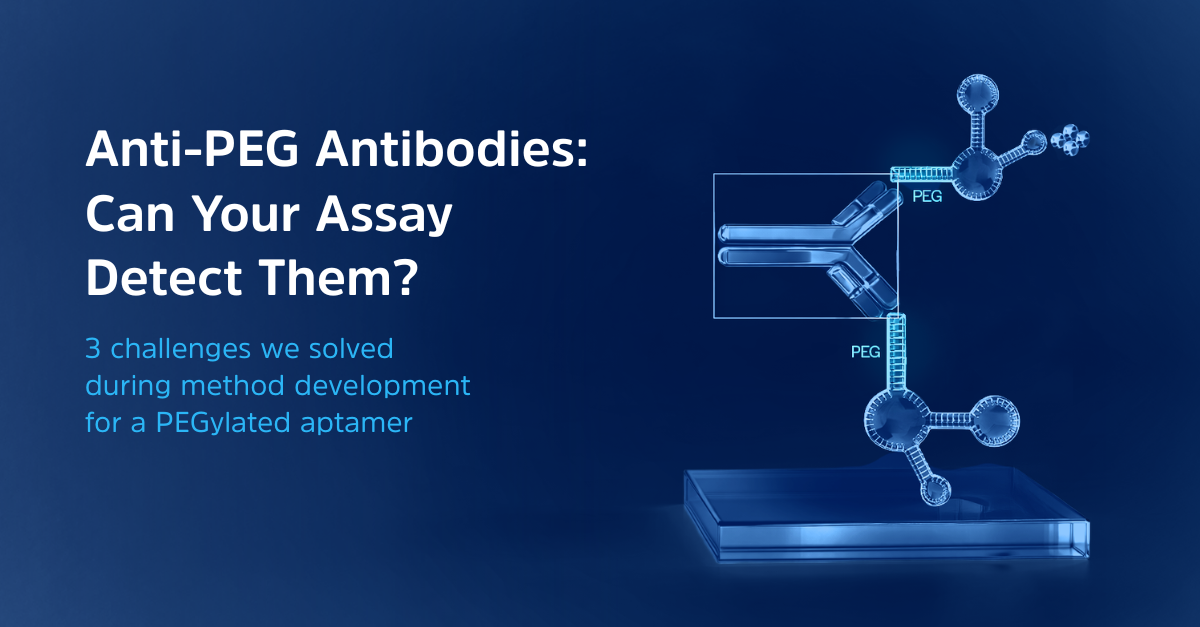
The underlying cause was traced to the repetitive motifs within the PEG molecule: because a single PEG chain contains multiple identical ethylene oxide units, anti-PEG antibodies could bind with both arms to the biotin-labeled AON-D21 capture reagent, occupying all available PEG epitopes and leaving no accessible binding site for the detection reagent.
To overcome this, the team transitioned to an Affinity Capture Elution–AGL (ACE-AGL) assay design. In this format, a Meso Scale Discovery (MSD) plate coated with AGL protein is used to capture and orient the positive control antibody in a defined position. This orientation allows the sulfo-tag-labeled AON-D21 detection reagent to bind successfully to the anti-PEG and anti-AON antibodies. The ACE-AGL format produced substantially higher S/N ratios, with clear differentiation between positive control concentrations ranging from 100 to 12,700 ng/mL.
Achieving universal detection across all antibody isotypes
A second requirement was to ensure the assay could detect anti-PEG antibodies of all isotypes (IgG, IgM and others) using a single detection reagent independent of the species origin of the positive control. During assay design evaluation, the step-wise format using an anti-species sulfo-tag produced the highest S/N ratios, as it binds to the Fc region of the positive control antibody, bypassing PEG's binding-site competition problem. However, this approach was inherently limited: an anti-species reagent only recognizes antibodies from a specific species and would require replacement with any change in positive control and the use of a different detection antibody to detect human antibodies .
The ACE-AGL format resolved this constraint by using sulfo-tag-labeled AON-D21 as the detection reagent instead of an anti-species conjugate, achieving species-independent, universal detection of all ADA isotypes in human serum. This was essential for clinical sample analysis, where the full spectrum of patient immune responses must be detected.
Selecting the optimal positive control antibody
The choice of positive control antibody directly impacts assay sensitivity, reproducibility, and the ability to distinguish between concentration levels. For the AON-D21 assay, six different anti-PEG antibodies were evaluated across multiple assay designs, including human, rat, mouse, and rabbit monoclonal antibodies, as well as IgG and IgM standards. Most positive controls produced low S/N ratios in the initial formats, while only a subset generated usable signals when transferred into the ACE-AGL design.
Importantly, antibodies can either bind to the backbone or the terminal methoxy group of the PEG molecule and thus display different specificity profiles which can influence assay performance [ref 3, 4]. In our study, the Rabbit monoclonal [PEG-B-47] antibody specific to the terminal methoxy group of the PEG was ultimately selected as the main positive control, providing the best S/N ratio differentiation across the tested concentration range (100 to 12,700 ng/mL).
Distinguishing anti-drug antibodies from anti-PEG antibodies
In clinical immunogenicity testing, the assay must be able to determine presence of antibodies directed against the PEG moiety and those targeting the drug molecule itself [ref 5]. For the AON-D21 molecule, the challenge was that no positive control capable of recognizing the oligonucleotide portion was available, so differentiation had to be achieved through assay design. The solution was the use of two competitors, unlabeled AON-D21 (the complete drug) and PEG alone in the confirmatory tier. High inhibition with unlabeled AON-D21 but not PEG indicates anti-oligonucleotide antibodies, while similar inhibition with both competitors indicates presence of only anti-PEG antibodies. Validation demonstrated inhibition values of 97.4% (AON-D21) and 92.7% (PEG) at 12,700 ng/mL positive control concentration, with the confirmatory tier verified across the full 100–12,700 ng/mL range.
Ready to discuss your next immunogenicity testing strategy?
Anapharm Bioanalytics' large molecule bioanalysis team has hands-on experience solving technical challenges, with validated immunogenicity methods supporting clinical programs from Phase I through regulatory submission.
Whether you need a custom ADA or anti-PEG antibody assay developed from scratch, a method transferred and cross-validated, or strategic guidance on your immunogenicity testing plan, we can help.
Speak with a bioanalytical specialist.
References
[ref 1] Chen BM, Cheng TL, Roffler SR. Polyethylene Glycol Immunogenicity: Theoretical, Clinical, and Practical Aspects of Anti-Polyethylene Glycol Antibodies. ACS Nano. 2021;15(9):14022–14048.
[ref 2] https://www.anapharmbioanalytics.com/poster-challenges-in-the-development-of-a-method-for-the-detection-of-anti-pegylated-aptamer-a-ntibodies/
[ref 3] Sherman MR, Williams LD, Sobczyk MA, et al. Role of the Methoxy Group in Immune Responses to mPEG-Protein Conjugates. Bioconjugate Chemistry. 2012;23(3):485–499.
[ref 4] Szebeni J, Barenholz Y. Anti-PEG antibodies: Properties, formation, testing and role in adverse immune reactions to PEGylated nano-biopharmaceuticals. Advanced Drug Delivery Reviews. 2020;154–155:163–175.
[ref 5] FDA. Immunogenicity Testing of Therapeutic Protein Products — Developing and Validating Assays for Anti-Drug Antibody Detection. Guidance for Industry. February 2019.


MORE NEWS
Webinar #1: Navigating Bioanalytical Challenges: from Small Molecules to Complex Peptides
In this 30-minute on-demand webinar, discover practical strategies to troubleshoot common analytical challenges, from small molecules to complex peptides, illustrated with real case studies from our laboratory.
Protein Digestion for LC-MS Bioanalysis: Comparing Standard and Kit-Based Methods
Quantitative bioanalysis of therapeutic proteins via liquid chromatography–mass spectrometry (LC-MS) typically relies on the analysis of surrogate peptides rather than intact proteins. Selecting the right digestion method impacts sensitivity, reproducibility, and cost. This blog compares three approaches tested in-house at Anapharm: standard trypsin digestion, the use of a kit with a thermostable immobilized trypsin, and a kit with ready-to-use reagents.
Tissue Sample Homogenization Strategies for LC-MS/MS Bioanalysis: Mechanical, Enzymatic, and Chemical Methods
Tissue sample homogenization strategies for LC-MS/MS bioanalysis for skin, brain, and challenging matrices. Solve homogenization and matrix effect challenges.