
12/18/2025
Protein Digestion for LC-MS Bioanalysis: Comparing Standard and Kit-Based Methods
Protein Digestion for LC-MS Bioanalysis: Comparing Standard and Kit-Based Methods
Summary
Quantitative bioanalysis of therapeutic proteins via liquid chromatography–mass spectrometry (LC-MS) typically relies on the analysis of surrogate peptides rather than intact proteins. Selecting the right digestion method impacts sensitivity, reproducibility, and cost. This blog compares three approaches tested in-house at Anapharm: standard trypsin digestion, the use of a kit with a thermostable immobilized trypsin, and a kit with ready-to-use reagents. Our results indicate that standard digestion provides good sensitivity with a cost-efficient workflow, whereas commercial kits excel in high-throughput applications and greater ease of use.
Do you need help choosing the right protein-digestion strategy for your next bioanalytical study? Talk to a bioanalytical specialist today.
Why does protein digestion matter in quantitative LC-MS bioanalysis?
Intact proteins are very challenging to quantify directly by LC-MS, due to their high heterogeneity, poor ionization efficiency, and inconsistent chromatographic performance. A common practice is to enzymatically cleave proteins into smaller surrogate peptides, which are easier to quantify and function as indirect measures of the intact protein. Trypsin is the gold standard enzyme for this process, due to its high specificity, cleaving at lysine and arginine residues, when not followed by a proline. The quality of digestion directly impacts quantification accuracy because incomplete cleavage can lead to variable peptide yields, poor reproducibility, and unreliable results.
What does a standard protocol for trypsin digestion entail?
Standard protocols for the tryptic digestion of a protein often involve a three-step process that cleaves proteins into peptides for LC-MS analysis. The first step involves the reduction with dithiothreitol (DTT) at 60°C to break disulfide bonds that hold proteins in their folded structure. Second, alkylation with iodoacetamide (IAA) caps free sulfhydryl groups to prevent bonds from reforming. In the last step, trypsin cleaves the unfolded protein during overnight incubation at 37°C. Complete digestion requires optimization of each step based on the specific characteristics of each protein.
How do you choose a digestion protocol for your bioanalytical study?
When choosing a protein‑digestion protocol for a bioanalytical study, four factors may be particularly important to evaluate: sensitivity, throughput, regulatory compliance, and per‑sample cost. Studies targeting low limits of quantification (LLOQs) require methods with complete digestion efficiency. High-throughput screening prioritizes speed, while regulated GLP studies require validated methods with demonstrated reproducibility. Budget constraints also influence this decision.
At Anapharm, we evaluated three protein digestion approaches using a 24 kDa model protein: our in-house standard trypsin digestion protocol, the use of a kit with a thermostable immobilized trypsin, and a ready-to-use reagents kit. In our case, each approach offered different strengths that could help define the digestion strategy depending on the characteristics of the protein target, matrix complexity, and assay objectives.
Standard trypsin protocol
A common standard digestion protocol involves a reduction step with DTT at 60°C, alkylation with IAA at room temperature, and overnight enzymatic digestion with sequencing-grade trypsin at 37°C. After digestion, the peptide mixture can be purified following different strategies to remove interfering substances before LC-MS analysis.
In our evaluation using a 24 kDa model protein, we followed the common protocol mentioned above together with a solid-phase extraction to purify the peptide mixture. This method achieved the best cleavage efficiency, the highest signal-to-noise ratio, and the lowest LLOQ at 0.2 µg/mL. Generally, standard digestion protocols are more labor-intensive and require expertise for careful optimization, although the high reliability, flexibility, and lower cost can justify the investment.
When can you use standard trypsin digestion?
Standard digestion protocols can be a good choice when aiming for a cost-efficient solution. Besides, it also provides valuable flexibility during method development, allowing researchers to fine-tune parameters such as incubation times, reagent concentration, or temperature conditions to achieve the best possible digestion yield.
Thermostable immobilized trypsin kit
This kit simplifies protein digestion using immobilized, heat-stable trypsin operating at 70°C. This elevated temperature promotes protein unfolding and eliminates the need for chemical reduction and alkylation. The workflow is minimal: add 150 µL of buffer to 50 µL of sample, incubate with shaking at 1,400 rpm, and proceed to analysis. The kit supports protein concentrations from 200 pg to 3.5 mg.
Our testing revealed time-dependent digestion efficiency: 33.5% at 3 hours, 77.8% at 6 hours, and 96% overnight. Although peptide peak intensity was slightly lower than that achieved with standard digestion, the kit provides several important advantages. It requires less specialized expertise, is easier to use and integrate into existing workflows, reduces hands‑on labor, and is considerably more compatible with automation, despite its higher cost.
When can you use the thermostable immobilized trypsin kit?
This kit is best suited for high‑throughput studies, automated workflows, time-sensitive projects, and laboratories with limited expertise in protein digestion.
Ready-to-use reagents kit
This kit offers modular workflows for proteins of varying complexity: a 3-step protocol for simple proteins and a 5-step protocol including reduction and alkylation for proteins with extensive disulfide bridges. This flexibility allows laboratories to tailor sample preparation to each specific analyte.
Digestion uses a surfactant and is carried out with reconstituted trypsin at 45°C for a minimum of two hours. The digestion step requires no agitation, which simplifies automation and high-throughput implementation. Moreover, the kit supports sample volumes between 15 and 70 µL of plasma, with 35 µL being optimal.
Our in-house results showed only 62.4% digestion completeness for the 24 kDa model protein after overnight incubation, which was lower than both the standard (100%) and the thermostable immobilized trypsin kit (96%) methods. This kit offers several advantages: the surfactant can help shorten digestion times, the ready‑to‑use reagents improve reproducibility between batches, the workflow is less labor‑intensive than standard digestion, and it provides greater flexibility than the thermostable immobilized trypsin kit.
When can you use the ready-to-use reagents kit?
This kit sits in an intermediate position between the two other strategies. With a similar cost to the thermostable immobilized trypsin kit and slightly harder to implement in an automatic workflow, it offers better flexibility through its 3‑ or 5‑step protocol, and it does not require extensive expertise thanks to its ready‑to‑use reagents.
Why is optimizing digestion efficiency important?
Digestion efficiency depends on protein characteristics, including molecular weight, disulfide bond content, glycosylation, and structural complexity. Small, soluble proteins with few disulfide bridges digest efficiently with minimal optimization, while larger or heavily cross-linked proteins may require adjusted enzyme ratios, extended incubation, or additional reduction and alkylation steps.
Wrapping Up: takeaways from each digestion strategy evaluated
Selecting the most appropriate digestion strategy depends on several factors, including protein complexity, laboratory expertise, throughput requirements, and sensitivity needs. Standard trypsin digestion remains the strongest option for complex, highly crosslinked proteins because it offers full control over each step and can achieve good sensitivity and digestion efficiency, while keeping the whole workflow cost-effective. In contrast, the commercial kits may sacrifice some flexibility and digestion yield in exchange for speed, ease of use, and strong reproducibility, supported by readytouse reagents and standardized workflows. These commercial kits are particularly well-suited for simple proteins, highthroughput environments, lower sensitivity requirements, and laboratories with limited experience in protein digestion.
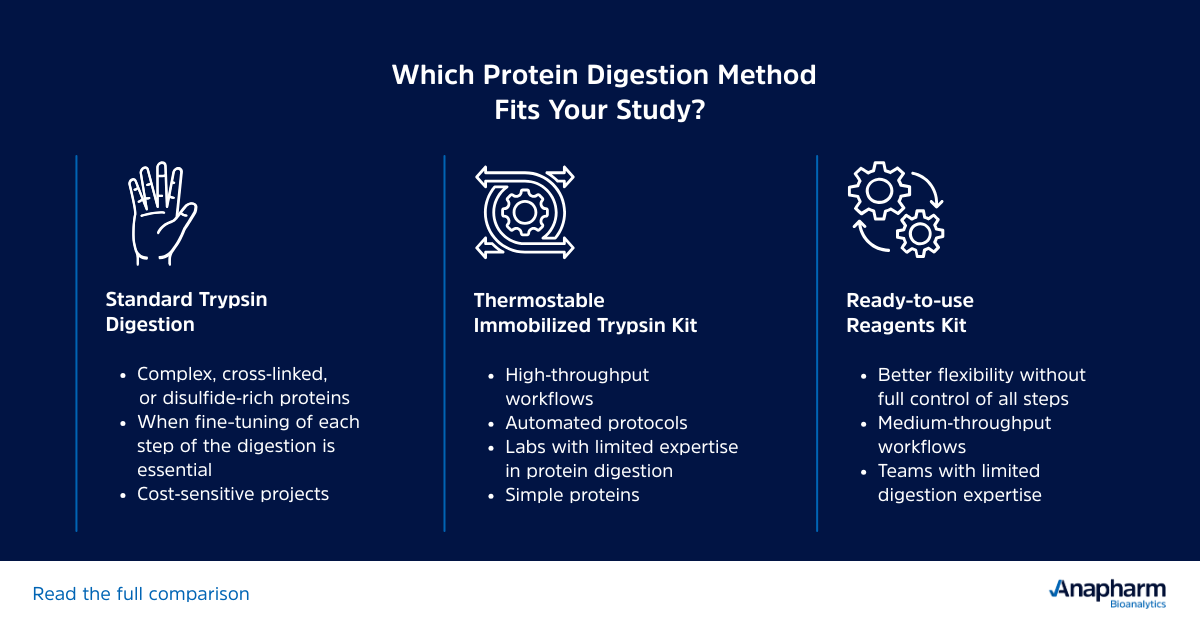
Best Use Cases
Standard Trypsin Digestion:
• Complex, crosslinked, or disulfiderich proteins
• When fine-tuning of each step of the digestion is essential
• Costsensitive projects
Thermostable immobilized trypsin kit:
• Highthroughput workflows
• Automated protocols
• Labs with limited expertise in protein digestion
• Simple proteins
Ready-to-use reagents kit:
• Better flexibility without full control of all steps
• Mediumthroughput workflows
• Teams with limited digestion expertise
Ready to discuss your next bioanalytical project?
Anapharm Bioanalytics develops LC‑MS digestion–based quantification methods for therapeutic proteins with a strong focus on regulatory readiness. This approach enables a seamless transition to fully validated GLP methods, minimizing delays and reducing the risk of costly method‑transfer challenges.
Speak with a bioanalytical specialist.
Looking for readily available bioanalytical methods?
Explore our developed method library.
References
https://pmc.ncbi.nlm.nih.gov/articles/PMC4287296/


MORE NEWS
Challenges in the development of a method for the detection of Free Testosterone
In the present study, we aim to optimize a competitive enzyme-linked immunosorbent assay (ELISA) for the measurement of free testosterone within a regulated pharmacokinetic (PK) framework, with the objective of achieving a sensitivity in the range of 0.2–0.6 pg/mL. This poster presents key challenges encountered during method development and validation, and discusses the strategies implemented to overcome them.
Anapharm Bioanalytics GLP Certificate Renewal
Barcelona, July 2026– Anapharm Bioanalytics is pleased to announce the successful renewal of its Good Laboratory Practice (GLP) certification following the latest inspection conducted by local authority, Generalitat de Catalunya, in June 2026.
Anapharm has operated under GLP compliance since 2003 and the renewed certificate is valid until June 2028. The recent on-site inspection concluded with no observations and no findings, an outstanding result that reflects the robustness of the company’s quality system.
Computerized Systems Validation in Bioanalysis: Regulatory Requirements and How It Works in Practice
In this blog post, we will take a closer look at the importance of CSV in a GLP & GCP environment and explore some of the key computerized systems that play a critical role in supporting our laboratory operations and ensuring data quality.